Showing posts with label History. Show all posts

Toyota Landcruiser Engines - Brief History


Toyota Landcruiser Engines - Brief History


The Toyota Landcruiser line consists of a series of four wheel drive vehicles that were built by the Toyota Motor Corporation The earliest model began development in 1951 and entered production in 1954 then named the Toyota jeep BJ.Toyota Land cruiser's are very popular due to their reliability and long life spans.
The 20 Series:
In 1955 Toyota came out with a revised edition called the 20 series. It was designed more towards civilians than the military for export reasons. The interior was made more comfortable by moving the engine forward 120mm. In 1958 the very first station wagon Landcruiser was introduced.
The 40 Series:
In 1960 the 20 series got an upgrade to the 40 series with production changes resulting in buying new steel presses in its factories. In 1965 the Landcruiser surpassed 50,000 in global production This was trumped in 1968 by passing the 100,000 mark, then again in 1972 to hit the 200,000 mark. The following year they breached the 300,000 mark for vehicles sold worldwide. In 1974 a four cylinder 3.0 litre diesel engine was offered In 1975 the 3.9 litre petrol engine was replaced with a larger 4.2 litre version In 1981 all diesel versions were fitted with front disc brakes
The 50 Series:
In 1967 the production of the FJ55 version of the Landcruiser began. This was a four door estate version that was based o the 40 series drive train. This model became known as "the moose" or the "iron pig" as its weight and power were formidable at that time.
The 60 Series: (Samurai)
This model was available from 1981 through 1987. It was a front engine configuration with four doors which allowed seating of between five to seven passengers. In 1980 the first 60 series Landcruiser was introduced.In 1985 direct injection engines and turbo charged diesels were available In 1988 the original petrol engine was upgraded to a 4 litre engine.
The 70 Series:
It was 1984 when Toyota released its first 70 series of the line. In 1990 new generation diesel engines were introduced In 1993 a 24 valve 4.5 litre six cylinder petrol engine was added In 1999 Toyota made several improvements to the 70 series. From lengthened rear leaf springs to increase comfort to a coil spring suspension for the solid front axle. In 2007 Toyota released its first turbo diesel v8 engine
The 80 Series: (Lexus LX450/Toyota Autana)
In 1990 the 80 series was first introduced, it replaced the 60 series. In 1995 there was an addition of drivers and passenger side air bags In 1997 there was a limited run of Landcruiser 80's marketed as a "collector's edition" 2008 saw the end of the Landcruiser 80 line
The 90 series (Prado)
In 1996 Toyota added the Prado to the Landcruiser line
The 100 Series (Lexus LX 470/Landcruiser Amazon)
In 1998 Toyota launched the 100 series to replace the then 8 year old 80 series.
The 200 Series: (Lexus LX570)
The 200 series was launched in 2008
Engines available by Series:
20 Series:
  • 3.9 L-F-6-P
40 Series:
  • 3.9 L-F -6-P
  • 4.2 L-2F-6-P
  • 3.0 L-B-4-D
  • 3.2 L-2B-4-D
  • 3.4 L-3B-4-D
  • 3.6 L-H-6-D
50 Series:
  • 3.9 L-F-6-P
  • 4.2 L-2F-6-P
60 Series:
  • 3.4 L-3B-4-D
  • 3.4 L-3B-T-4-D-TURBO CHARGED
  • 4.2 L-2F-6-P
  • 4.0 L-3F-6-P
  • 4.0 L-2H-6-D
  • 4.0 L-12H-T-6-D-TURBO CHARGED
70 Series:
  • 2.4 L-22R-4-P
  • 4.0 L-3F-6-P
  • 4.5 L-1FZ-6-P
  • 2.4 L-2L-4-D
  • 3.4 L-PZ-5-D
  • 4.0 L-2H-6-D
  • 4.2 L-1HZ-4-D
  • 2.4 L-2L-T-4-D-TURBO CHARGED
  • 3.4 L-13B-T-4-D-TURBO CHARGED
  • 4.2 L-1HD-6-D-TURBO CHARGED
  • 4.5 L-1VD-8-D-TURBO CHARGED
80 Series:
  • 4.0 L-3F-E-6-P
  • 4.5 L-1FZ-6-P
  • 4.2 L-1HZ-6-D
  • 4.2 L-1HD-6-D-TURBO CHARGED
100 Series:
  • 3.4 L-5VZ-FE-6-P
  • 2.7 L-3RZ-FS-6-P
  • 3.0 L-1KZ-TE-4-D-TURBO CHARGED
  • 4.5 L-1FZ-6-P
  • 4.2 L-1HD-T-6-D-TURBO CHARGED
  • 4.2 L-1HD-FT-6-D-TURBO CHARGED
  • 4.2 L-1HZ-6-D
  • 4.7 L-2UZ-8-P
200 Series:
  • 4.0 L-1GR-6-P
  • 5.7 L-3UR-8-P
  • 4.7 L-2UZ-FE-8-D
  • 4.5 L-1VD-8-D-TURBO CHARGED
  • 4.6 1UR-1UR-8-P
Wayne Adams is an expert in Toyota Landcruiser Engines. If you are interested in learning more about quality Toyota Landcruiser Engine, please contact us by visiting our main site: http://www.idealengines.co.uk/ or by calling us at +442085960396

The History of Toyota


Toyota is one of the best car selling companies in the world. TMC (Toyota Motor Corporation) was established in Tokyo, Japan. The company was founded in the year 1937 by a successful businessman - Mr. Kiichiro Toyoda.
The company is a corporation in the Toyota City in Tokyo. Some say that the company is not one of the best companies but the only best and the largest motor making company in the world. Today, there are more than 317,000 people working in this company as its dedicated employees. The world has seen its triumph soon after the World War and the cars that were created by this company were really amazing and there is no doubt about it. It was the year 1934 when Toyota Industries created its first ever product by the name Type A engine which rocked the market of automobiles. Ford and many other well known companies knew that they got their rival and competitor.
The company did not stop creating anything and they kept on creating more and more powerful things without stopping. In the year 1936, Toyota created a history by introducing a new passenger car- Toyota AA. Toyota also has other brands which are very famous worldwide and are known as Scion and Lexus. These cars have great deals and they have majority of their shareholdings in Daihatsu and Hino Motors. Did you know? The company alone holds about 522 subsidiaries, and this makes the company the largest automaker in the world.
Besides making cars, the company also has its wings in other sectors such as financial sector. The name of this branch is Division Toyota Financial Services. This company also plays a crucial role in financial sector and gives loans and financial assistance to the people who are in need of capital. Toyota Group is the largest group of industries in the world.
However, Toyota motors limited has seen a huge loss of about 5 billion US dollars due to internal issues. After the financial crisis that happened due to American people, Toyota lost a lot of shares and stakes and money between the years 2007-2009. The recession that happened in the world was mainly due to Americans who did not pay their loans and taxes back to the country. Japan blamed America for doing such a cheap thing and people of America have gulped the money that other people gave as taxes. After gulping down, they kept mum and the whole world started suffering. Mr. Toyoda was traced quoting, "Americans are selfish, and indeed the world is suffering. God knows when they will think about others other than filling their own stomachs by snatching other's work". However, this was rubbished as a rumor but people still do believe that it did affect everyone.


The History of BMW


The History of BMW


Very few people in fact know the extent that the history of BMW is intertwined with world history, and that the company was in fact closed at the end of world war one as the result of the treaty of Versailles. Or; that that BMW traces its origins back over 100 years.
It all began back in the early part of the 1900s in Bavaria when three manufacturing companies joined together to form one business entity. Then after some inside company politics were settled in 1916, and one of the original founders was ousted from his position as president, the company was renamed Bayerische Motorenwerke, by its then board of directors.
As stated above, the company was shuttered for around a year following the end of WW1 because at that time it made only airplane engines for military aircraft. You see the terms of the treaty of Versailles dictated that no arms could be manufactured in Germany, and Bavaria was a part of the German empire.
Of course they did eventually reopen about a year later under the ownership of a company by the name of BFW, to begin manufacturing industrial engines, and shortly thereafter underwent yet another name change. This time to BMW. It was also about this time that they began production of their first motorcycles.
Fast forward to 1929, and the BMW Company begins to produce automobiles after the acquisition of another company named Fahrzeugfabrik Eisenach. While there really is not much to be said about this first entrance into automobile manufacturing per se, none the less it did lead up to the production of the BMW 328 sports car in 1936.
It was also about that same time in the mid to late 1930s that the German war machine began to crank back up in violation of the terms of the treaty of Versailles, which in turn led to BMW once again getting into the business of military aircraft motor production. Even so, this wasn't a unanimous decision by the board of directors.
The director of the company, Franz Joseph Popp had not forgotten that it was BMWs participation in war materials production during the First World War that had almost let to its complete demise. So fast forward to the end of WW2 some nine years later, and his intuitions were to be proven correct as BMW was reduced to making simple pots, and pans to survive as a business entity.
As crazy as it sounds, it was the portion of the company that ended up in the hands socialist Russia on the eastern side of the line that divided Europe after WW2 that was the quickest to get back into the motorcycle, and automobile business. In fact it wasn't until 1952 that BMW was back in the business of producing cars in the country of Bavaria.
Even then, sales of the cars were so dismal that there came a point where the company's board of directors found themselves seriously considering a buyout proposition from Daimler Benz. The deal most likely would have gone through, if a wealthy industrialist by the name of Herbert Quandt had not stepped in to purchase a controlling interest and also offer is business acumen that has guided the company to where it is today.
Tyrrell Kumar Chriss writes for Stephen James BMW an award winning BMW London dealership. Visit the website to find out more.

BMW History


BMW History


Karl Friedrich Rapp is the name of the founder of BMW - one of the biggest world wide car manufacturing companies. BMW or Bayerische Motoren Werke (Bavarian Motor Works) was founded in 1916 as a successor to the Rapp Motor.
Many people think that the logo of BMW comes from a spinning white propeller seen in the background of the blue sky. This may be so but in fact it is known that it also comes from the white and blue flag of Bavaria - the largest state of Germany. The capital city of the state is Munich and this is the place where even today we can find the BMW Headquarters.
In 1916 with the foundation of the company a contract was secured for building V12 engines. These engines were about to be used in the creation of the automobiles from Austro-Daimler. These 12 cylinders V engines were at first used in aircrafts which is the original plan of the BMW Company. Taking in account the time when the company was founded it was very likely for them to continue like that.
However in 1919 after the World War I and the Treaty of Versailles the production of aircraft in Germany was prohibited and that quickly changed the politics of BMW. They began making brakes for the Rail transport. Soon after that BMW was able to design a motorcycle engine which was used for the creation of a motorcycle called with the model name Victoria. However Victoria was not built by BMW but by another company in Nuremberg.
In 1924 BMW made a model of a motorcycle which was the first one they built - the R32. This was a turning point in the BMW history because it was a major achievement and for decades they used its technology - 500 cc engines cooled down by the air. Soon after that BMW added one new innovation - the driveshaft. It came to replace the chain for driving the rear wheel and became a mark of BMW for quite some time.
In the German city Eisenach in 1927 began the production of Dixi - under license but only a year after that the Dixi Company was bought by BMW and they began mass production together with the model Austin Seven.
When the World War I began BMW took its place in it because of the German army's motorized division. They used BMW R75 together with BMW R12. Because of the high need of engines BMW note that period as highly profitable. BMW was the main supplier and even today words like Luftwaffe and Wehrmacht brings many memories. Some of the best planes in that historical time used the BMW aero-engines and till the 1945 more than 30 000 planes with these engines were manufactured.
BMW even made researches which enabled the company to make different jet engines for weapons. With the use of some men power consisting mainly by prisoners of the war BMW made many rocket-based weapons that were used in the war.
Soon after the creation of the rocket-based weapons parts of the company were bombed. Soviets razed to the ground most of the company located in eastern Germany and the base factory in Munich was almost completely destroyed.
After the war BMW was not able to quickly recover because of the need to rebuild the factory in Munich. After that when the restrictions from the Allies applied BMW was banned for three long years in which the company was forbidden from producing motorcycles until 1948 and cars until 1952.
In 1951 the Bavarian company was able to regain all trademarks and it looked like it was finally able to recover and start again from what was left. In 1959 Herbert Quandt became the "wheel" which turned the BMW around because he denied a deal with Daimler-Benz and soon after that he increased his share in the BMW Company up to 50%.
The name of Kurt Golda is stated as the man who incited Quandt to do this step and in the same year BMW began production of the BMW 700 which was based on the BMW 600. This small car used 2-cylinder, air-cooled engines and some years later it was renamed to "LS". Coupe and some cabriolet series were also manufactured.
In 1963 BMW offered dividends to the shareholders of the company and in 1966 the factory in Munich reached its maximum capacity and BMW bought Hans Glas GmbH. This deal enabled BMW to use factories in Landshut and Dingolfing.
With some new style provided by Bertone in 1972 BMW began production of 5 new series and in the years to follow the company made a big progress in the market. For 6 years under the leadership of Bernd Pischetsrieder BMW was able to expand its deal in the market by buying from British Aerospace the Rover Group. Rover Group's history starts in 1986 and till the moment when BMW owned it this company was able to achieve many things like for example the Rover 400 in 1990.
However the Rover was sold to Phoenix Venture Holdings and Ford Motor Company because of some years of losses for BMW. Jokingly the press called the Rover "The English Patient" after the release of the namesake film. This however was not very hard on BMW and they were spared from taking the blame. It looks like that even the British press was not very enthusiastic about the Rover.
BMW began production outside of Germany in 1994. New factories were made in South Carolina and even today the manufacturing of BMW X5 and BMW Z4 is made there. There are factories in some other places too like Oxford, Goodwood and others. After some time of assembly BMW began production in South Africa. Today BMW exports more than 50 000 3 Series vehicles yearly to Japan, USA, Africa, Australia and the Middle East.
In order to serve the market in Eastern Europe and Middle East BMW are planning to begin construction of a new plant located in Cyprus or Greece. A plant in Chennai, India already opened production in 2007.

History of BMW


History of BMW


Bayerische Motoren Werke AG, in English, Bavarian Motor Works, like Mercedes-Benz is a German automobile manufacturer. The man behind this was Karl Friedrich Rapp. This started in the year 1913. It was not known to everyone that BMW was then a manufacturer of aircraft engines. Rapp established "Rapp-Motorenwerke" in Munich. He started to manufacture his own aircraft engines. Unfortunately, they suffered from problems with vibrations.
Rapp Motoren Werke experienced different problems with the reliability of the aircraft engines. Due to financial problems, Rapp decided to resign from the company in the year 1916. Two Austrians then took over. They were Franz-Josef Popp and Max Fritz. They were able to convince Gustav Otto to merge with them. The merging of the "Gustav Flugmaschinefabrik" and "Bavarian Aircraft Works" gave birth to Bayerische Flugzeug-Werke. The company was then renamed to BMW and in 1918 became BMW AG.
The very first aircraft engine of BMW, Type Illa, was produced during the year 1917. It features a unique "high-altitude carburetor" developed by Fritz that allows it to develop full power at altitude.
After a year, the said aircraft engine powered a biplane to 5,000 meters altitude in just 29 minutes. During those days, it was already a very impressive performance. It then led to the strong demand for BMW engines.
The successor of Type Illa was born in the year 1919. It was named Type IV. With this new engine, Franz Zeno Diemer was able to set an altitude record of 9, 760 meters.
The present logo of BMW seen in the cars today was introduced in the early 1920s. It was based on the circular design of an aircraft propeller.
The company thought of other products and so they started to build engines for motorcycles. They designed the M2 B 15 for the "Victoria" motorcycle. This was the first BMW motorcycle engine and was produced from 1920 to 1922. The first motorized bicycle named "Flink" paved its way in the year 1921. It was powered by a Kurier two stroke engine. In 1922, the first BMW factory was built.
The year 1928 marked the beginning of the BMW car. The company bought the car factory at Eisenach/Thuringia and with it the license to build a small car called the Dixi 3/15. the Dixi was the counterpart of Austin 7. The German version of Dixi was BMW Dixi DA/1. This period was the best for BMW since it was beginning of all the success it is experiencing until now.
As you can see, the early days of BMW history began in aircraft technology and today are deeply rooted in automotive innovations. The Germans have a reputation for producing finely crafted, reliable and fun to drive cars - and BMW plays a large part in that success.

Why People Are Crazy for BMW?


Why People Are Crazy for BMW?


There are numerous reasons why people are crazy to buy the BMW brand cars. If you ever happen to consider all the reviews related to the BMW cars then you will come to know that they are extremely impressive and inspiring. Therefore, you must be thinking that what could be some of the particular reasons because of which people prefer buying BMW cars? Until now, there have been several reasons that have been explored and the primary one is the dedication and commitment towards the quality, which the company is offering. All the cars that are manufactured are known to truly show evidence of high-class quality.
The automobile engineering experts and professionals at BMW are extremely organized and they come up with unique and distinct vehicle manufacturing plans. Thus, this is one of the reasons why BMW gets extremely well designed vehicles that normally comprise of accurate parts that are useful in having a smooth and comfortable driving experience. Since its origin, the company is truly committed to the quality aspect and people all around the world find this one particular reason sufficient to buy BMW cars. The firm has expanded its operations all around the globe mainly including the United States of America and they like buying BMW cars as much as they prefer having Ford or Chevrolet.
All such people who prefer buying BMW cars also like sharing their experiences related to the superior level of comfort. You can drive as fast as you want and this is the comfort, which is provided to you. You can race ahead with a classy and comfortable ambiance.
You can truly depend on the authenticity and reliability of the brand while you are considering buying BMW Cars on the other hand, you can check out these links to make sure that you are getting the best automotive deals Cars

History of Cars

What Was The First Car?
A Quick History of the Automobile for Young People


by William W. Bottorff


Several Italians recorded designs for wind driven vehicles. The first was Guido da Vigevano in 1335. It was a windmill type drive to gears and thus to wheels. Vaturio designed a similar vehicle which was also never built. Later Leonardo da Vinci designed a clockwork driven tricycle with tiller steering and a differential mechanism between the rear wheels.


A Catholic priest named Father Ferdinand Verbiest has been said to have built a steam powered vehicle for the Chinese Emperor Chien Lung in about 1678. There is no information about the vehicle, only the event. Since Thomas Newcomen didn't build his first steam engine until 1712 we can guess that this was possibly a model vehicle powered by a mechanism like Hero's steam engine, a spinning wheel with jets on the periphery. Newcomen's engine had a cylinder and a piston and was the first of this kind, and it used steam as a condensing agent to form a vacuum and with an overhead walking beam, pull on a rod to lift water. It was an enormous thing and was strictly stationary. The steam was not under pressure, just an open boiler piped to the cylinder. It used the same vacuum principle that Thomas Savery had patented to lift water directly with the vacuum, which would have limited his pump to less than 32 feet of lift. Newcomen's lift would have only been limited by the length of the rod and the strength of the valve at the bottom. Somehow Newcomen was not able to separate his invention from that of Savery and had to pay for Savery's rights. In 1765 James Watt developed the first pressurized steam engine which proved to be much more efficient and compact that the Newcomen engine.


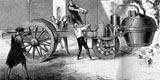
The first vehicle to move under its own power for which there is a record was designed by Nicholas Joseph Cugnot and constructed by M. Brezin in 1769. A replica of this vehicle is on display at the Conservatoire des Arts et Metiers, in Paris. I believe that the Smithsonian Museum in Washington D. C. also has a large (half size ?) scale model. A second unit was built in 1770 which weighed 8000 pounds and had a top speed on 2 miles per hour and on the cobble stone streets of Paris this was probably as fast as anyone wanted to go it. The picture shows the first model on its first drive around Paris were it hit and knocked down a stone wall. It also had a tendency to tip over frontward unless it was counterweighted with a canon in the rear. the purpose of the vehicle was to haul canons around town.


The early steam powered vehicles were so heavy that they were only practical on a perfectly flat surface as strong as iron. A road thus made out of iron rails became the norm for the next hundred and twenty five years. The vehicles got bigger and heavier and more powerful and as such they were eventually capable of pulling a train of many cars filled with freight and passengers.


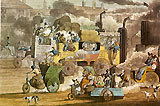
As the picture at the right shows, many attempts were being made in England by the 1830's to develop a practical vehicle that didn't need rails. A series of accidents and propaganda from the established railroads caused a flurry of restrictive legislation to be passed and the development of the automobile bypassed England. Several commercial vehicles were built but they were more like trains without tracks.


The development of the internal combustion engine had to wait until a fuel was available to combust internally. Gunpowder was tried but didn't work out. Gunpowder carburetors are still hard to find. The first gas really did use gas. They used coal gas generated by heating coal in a pressure vessel or boiler. A Frenchman named Etienne Lenoir patented the first practical gas engine in Paris in 1860 and drove a car based on the design from Paris to Joinville in 1862. His one-half horse power engine had a bore of 5 inches and a 24 inch stroke. It was big and heavy and turned 100 rpm. Lenoir died broke in 1900.


Lenoir had a separate mechanism to compress the gas before combustion. In 1862, Alphonse Bear de Rochas figured out how to compress the gas in the same cylinder in which it was to burn, which is the way we still do it. This process of bringing the gas into the cylinder, compressing it, combusting the compressed mixture, then exhausting it is know as the Otto cycle, or four cycle engine. Lenoir claimed to have run the car on benzene and his drawings show an electric spark ignition. If so, then his vehicle was the first to run on petroleum based fuel, or petrol, or what we call gas, short for gasoline.


Siegfried Marcus, of Mecklenburg, built a can in 1868 and showed one at the Vienna Exhibition of 1873. His later car was called the Strassenwagen had about 3/4 horse power at 500 rpm. It ran on crude wooden wheels with iron rims and stopped by pressing wooden blocks against the iron rims, but it had a clutch, a differential and a magneto ignition. One of the four cars which Marcus built is in the Vienna Technical Museum and can still be driven under its own power.


In 1876, Nokolaus Otto patented the Otto cycle engine, de Rochas had neglected to do so, and this later became the basis for Daimler and Benz breaking the Otto patent by claiming prior art from de Rochas.


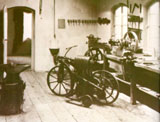
The picture to the left, taken in 1885, is of Gottllieb Daimler's workshop in Bad Cannstatt where he built the wooden motorcycle shown. Daimler's son Paul rode this motorcycle from Cannstatt to Unterturkheim and back on November 10, 1885. Daimler used a hot tube ignition system to get his engine speed up to 1000 rpm


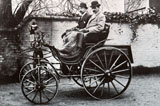
The previous August, Karl Benz had already driven his light, tubular framed tricycle around the Neckar valley, only 60 miles from where Daimler lived and worked. They never met. Frau Berta Benz took Karl's car one night and made the first long car trip to see her mother, traveling 62 miles from Mannheim to Pforzheim in 1888.


Also in August 1888, William Steinway, owner of Steinway & Sons piano factory, talked to Daimler about US manufacturing right and by September had a deal. By 1891 the Daimler Motor Company, owned by Steinway, was producing petrol engines for tramway cars, carriages, quadricycles, fire engines and boats in a plant in Hartford, CT.


Steam cars had been built in America since before the Civil War but the early one were like miniature locomotives. In 1871, Dr. J. W. Carhart, professor of physics at Wisconsin State University, and the J. I. Case Company built a working steam car. It was practical enough to inspire the State of Wisconsin to offer a $10,000 prize to the winner of a 200 mile race in 1878.>(see more on J. W. Carhart story from Fredric Dennis Williams)


The 200 mile race had seven entries, or which two showed up for the race. One car was sponsored by the city of Green Bay and the other by the city of Oshkosh. The Green Bay car was the fastest but broke down and the Oshkosh car finished with an average speed of 6 mph.


From this time until the end of the century, nearly every community in America had a mad scientist working on a steam car. Many old news papers tell stories about the trials and failures of these would be inventors.


By 1890 Ransom E. Olds had built his second steam powered car, pictured at left. One was sold to a buyer in India, but the ship it was on was lost at sea.


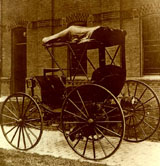
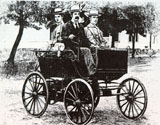
Running by February, 1893 and ready for road trials by September, 1893 the car built by Charles and Frank Duryea, brothers, was the first gasoline powered car in America. The first run on public roads was made on September 21, 1893 in Springfield, MA. They had purchased a used horse drawn buggy for $70 and installed a 4 HP, single cylinder gasoline engine. The car (buggy) had a friction transmission, spray carburetor and low tension ignition. It must not have run very well because Frank didn't drive it again until November 10 when it was reported by the Springfield Morning Union newspaper. This car was put into storage in 1894 and stayed there until 1920 when it was rescued by Inglis M. Uppercu and presented to the United States National Museum.


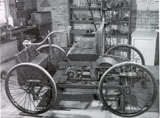
Henry Ford had an engine running by 1893 but it was 1896 before he built his first car. By the end of the year Ford had sold his first car, which he called a Quadracycle, for $200 and used the money to build another one. With the financial backing of the Mayor of Detroit, William C. Maybury and other wealthy Detroiters, Ford formed the Detroit Automobile Company in 1899. A few prototypes were built but no production cars were ever made by this company. It was dissolved in January 1901. Ford would not offer a car for sale until 1903.


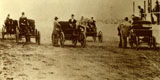
The first closed circuit automobile race held at Narragansett Park, Rhode Island, in September 1896. All four cars to the left are Duryeas, on the right is a Morris & Salom Electrobat. Thirteen Duryeas of the same design were produced in 1896, making it the first production car.


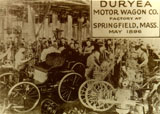
At left is pictured the factory with produced the 13 Duryeas. In 1898 the brothers went their separate ways and the Duryea Motor Wagon Company was closed. Charles, who was born in 1861 and was eight years older than Frank had taken advantage of Frank in publicity and patents. Frank went out on his own and eventually joined with Stevens Arms and Tool Company to form the Stevens-Duryea Company which was sold to Westinghouse in 1915. Charles tried to produce some of his own hare-brained ideas with various companies until 1916. Thereafter he limited himself to writing technical book and articles. He died in 1938. Frank got a half a million dollars for the Westinghouse deal and lived in comfort until his death in 1967, just seven months from his 98th birthday.


In this engraving Ransom Eli Olds is at the tiller of his first petrol powered car. Riding beside him is Frank G. Clark, who built the body and in the back are their wives. This car was running by 1896 but production of the Olds Motor Vehicle Company of Detroit did not begin until 1899. After an early failure with luxury vehicles they established the first really successful production with the classic Curved Dash Oldsmobile.


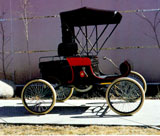
The Curved Dash Oldsmobile had a single cylinder engine, tiller steering and chain drive. It sold for $650. In 1901 600 were sold and the next years were 1902 - 2,500, 1903 - 4,000, 1904 - 5,000. In August 1904 Ransom Olds left the company to form Reo (for Ransom Eli Olds). Ransom E. Olds was the first mass producer of gasoline powered automobiles in the United States, even though Duryea was the first auto manufacturer with their 13 cars.


Ransom Olds produced a small number of electric cars around the turn of the century. Little is known about them and none survive. The picture at left is the only known picture of one of these rare cars. It was taken at was taken at Belle Island Park, Michigan. In 1899 and 1900, electrics outsold all other type of cars and the most popular electric was the Columbia built by Colonel Albert Augustus Pope, owner of American Bicycle Company.
an interesting footnote to the Olds electric.


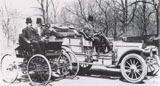
J. A. Koosen and H. Lawson in a 1895 Lutzmann. This is typical of American design in the mid 1890's. It was truly a horseless carriage. Tiller steering, engine under the floorboards, very high center of gravity, not designed for road travel. Imagine climbing into one of these and trying to drive across town and around a few corners. Kind of scary, huh?


This Daimler of 1899 was owned by Lionel Rothchild. The European design is much advanced of the American designs of the same time. Gottlieb Daimler took part in the London-to-Brighton run in 1896 but died in 1900 at the age of 66 without ever meeting Benz. His German engines powered the automobile industries of Britain and France.


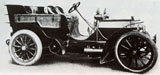
The 1908 Haynes in the back ground shows the rapid development of the petrol powered car when compared to the 1894 model in the foreground. Consider the present difference between a 1998 Tarus and the 14 year old 1984 Tarus. Some difference. Old man Haynes claimed to have build the 1894 car in 1893 but had no proof.


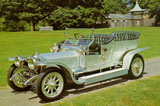
The Rolls Royce Silver Ghost of 1906 was a six cylinder car that stayed in production until 1925. It represented the best engineering and technology available at the time and these cars still run smoothly and silently today. This period marked the end of the beginning of the automobile.


How The Car Changed The County, Town by Town


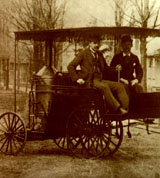
In 1903, in Winfield, Kansas Mr. H. T. Trice is seen standing in from of the first car in town. Acutally it was more like a truck and was used to haul customers out to see land. The railroads brought potential customers to town and Mr. Trice picked them up at the depot and took them out to his new developments.


Steam power was widely used in the 1880's and 1890's on the farms of America. Cowley County had its share of these behemoths and had a large group of people with the ability to use, and the skill to fix and repair them. The smaller, less expensive automobile, with an internal combustion engine provided a new avenue of interest that was much more personal than the steam engine with its team of attendants.


Mr. Martin Baden of Winfield, Kansas and his new eight-cylinder Cadillac roadster. This car was especially built for Mr. Baden, and was equipped with all modern appliances. Driving an automobile required a high degree to technical dexterity, mechanical skill, special clothing including hat, gloves, duster coat, goggles and boots. Tires were notoriously unreliable and changing one was an excruciating experience. Fuel was a problem, since gasoline was in short supply. Mr. Baden became interested enough to become a self-taught geologist and eventually discover major oil deposits in Cowley County, Kansas, and surrounding area.


The drivers of the day were an adventurous lot, going out in every kind of weather, unprotected by an enclosed body, or even a convertible top. Everyone in town knew who owned what car and the cars were soon to become each individuals token of identity. Notice the guy at the far right fixing his flat time. The dirt roads were a challenge in any weather. By 1910 Winfield paved the downtown streets with brick, horses were no longer welcome. The mule drawn trolleys were upgraded to electric streetcars.


By 1915 racing had become a passion all over the United States. A typical local race track was at the Cowley County Fairgrounds in Winfield, Kansas. The local obsession with horse racing, started by the earliest settlers in 1870, turned to the new technology of auto racing. Local farm boys who were familiar with motors and equipment used their talents on cars and motorcycles to go faster than anyone in the county.


The horse racing facilities were quickly converted to the new, faster, more dangerous, and thus more exciting, motor racing. See Bob Lawrence's Home Page for new sections on both Auto Racing and Motorcycle Racing in Cowley County, Kansas


Eventually the automobile change the face of small town America. The town gentry bought cars, albiet fashoned to match their station in life. In Winfield, Kansas, Main Street went from a gathering place for people and horses and wagons to a parking place for the ubiquitous automobile. The Trolley Cars were displaced to make room for more cars. The brick streets were covered with asphalt to provide a smoother ride for the automobile. The old fire maps of Winfield show the inexorable spread of the automobile and all of the supporting businesses. Filling stations, auto dealers, battery stations, oil depots all grew and expanded to displace to older technologies of the day. R. B. Sandford's Winfield Carriage Works appears on the fire-map of Block 127 in 1918. But on the same spot on Block 127 in 1925 it has been replaced by a Battery Station and an Auto Storage facility.


Midway through the century, cars had become a central feature of life for young people. The cars owned by the students of Winfield High School in the fifties are typical of every where in America at that time. It was mobility, status, challenge, and social freedom. It certainly hurt our football team at the time. A typical excuse for not playing on the football team was that a student had to work to earn money to pay for their car. When asked why they needed a car, the answer was invariably: to get to work!


After a century of the automobile, we can begin to assess the effects of long term transport by internal combustion. Nearly every aspect of our lives has developed around this technology. Only now, are we seeing new digital communications technologies, of the internet and beyond, that may eventually displace some of the functions of the automobile and replace our current problems with a new set that you, our grandchildren, will be charged with solving. Ask your grandparents about their first car. I'm sure you will get to hear a great story.


cugnots.jpg

You might also Like

Related Posts Plugin for WordPress, Blogger...
 
Design by Free WordPress Themes | Bloggerized by Lasantha - Premium Blogger Themes | Affiliate Network Reviews